darulmaarif.net – Indramayu, 01 July 2026 | 16.00 WIB
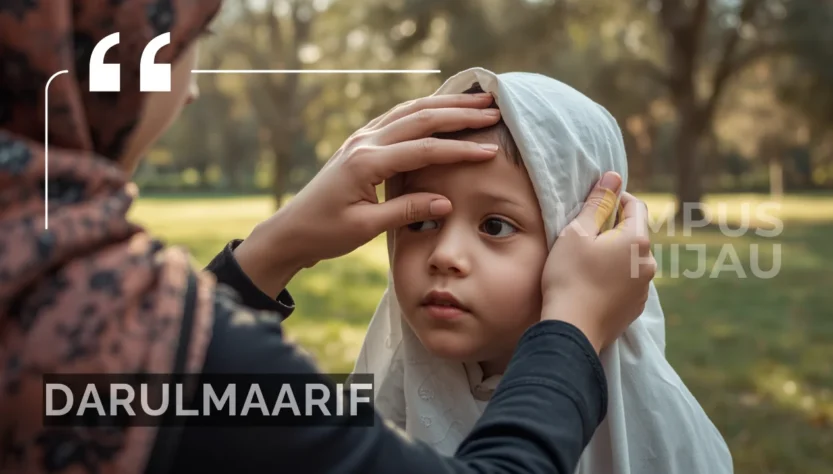
The month of Muharram is one of the holy months in the Islamic calendar which has many special features. One of the most famous practices is the Ashura fast on the 10th of Muharram. However, in society there are also various other practices that are often associated with the day of Ashura, such as giving alms in secret, visiting the sick, and stroking the heads of orphans.
So, does the practice of rubbing the heads of orphans specifically on the 10th of Muharram have any strong evidence? What are the views of the ulama regarding the meaning of rubbing the heads of orphans in Islam?
The following is an explanation based on information from scholars in classical books (turats).
The Proposition of Wiping the Heads of Orphans in the Month of Muharram
Among the narrations that are often mentioned in discussions of the virtues of the day of Ashura is the hadith narrated by Ibn Abbas’ friend, Lord Allah:
From the second hadith of Ibn Abbas radhiyallahu ‘anhu, he said: Rasulullah SAW said: Whoever fasts on the day of Ashura in the month of Muharram, then Allah SWT will reward him with ten thousand million dirhams, and whoever fasts on the day of Ashura in the month of Muharram, then he will be rewarded with ten martyrs, and whoever rubs his hand on the head of an orphan on the day of Ashura, then Allah SWT will raising it with every hair one degree.
Meaning: “Related from Ibn Abbas, may Allah be pleased with him, he said: Rasulullah SAW said: ‘Whoever fasts on the day of Ashura in the month of Muharram, Allah will reward him with ten thousand angels. rubbed.'” (Manaahiijul Imdaad I/521)
However, the scholars also explained that the history regarding the special virtue of wiping the heads of orphans on the 10th of Muharram is not a strong hadith. Therefore, this practice is not understood as a special obligation or sunnah that has provisions as strong as the fast of Ashura.
However, the general meaning of rubbing the heads of orphans and loving them has a basis in other hadiths that explain its importance.
Theorem The Virtue of Wiping the Heads of Orphans
In several histories, it is mentioned the importance of caring for and loving orphans.
From the hadith of Abu Umamah he said: Rasulullah SAW said: Whoever rubs the head of an orphan who only rubs it for the sake of Allah, then he gets goodness for every strand of hair that he passes over.
Meaning: “On the authority of Abu Umamah al-Bahili, may Allah have mercy on him and grant him peace, Rasulullah SAW said: ‘Whoever touches the head of an orphan and does not touch it except for the sake of Allah, then every strand of hair that passes through his hand will receive a good deed.'” (HR. Imam Ahmad and ath-Thobroni. His Sanad is considered dho’if)
Apart from that, there is also a hadith from Abu Hurairah radhiyallahu ‘anhu:
There was a man who complained to the Prophet SAW about his hard heart, so he said, “Feed the poor and wipe the heads of orphans.”
Meaning: “Indeed, a man complained to the Prophet SAW about his hard heart. So the Prophet SAW said: ‘Give food to the poor and stroke the heads of orphans.'” (HR. Imam Ahmad, sanad hasan)
As explained in Fathil Baari by Ibnu Hajar al-Asqalani XI/151, these hadiths show the virtue of being gentle towards orphans as a form of love and social concern.
What is the Meaning of Wiping an Orphan’s Head?
Scholars differ in understanding the meaning of “rubbing the head of an orphan”. Some scholars understand it essentially, namely actually rubbing the head as a form of affection. Others understand it as an expression (kinayah) of providing care, protection and kindness to orphans.
According to Imam Ibnu Hajar al-Haitami, the meaning of stroking in this hadith is the true meaning, namely touching the head of an orphan with great affection.
He says:
What is meant by wiping in the second hadith is its essence, as explained at the end of the hadith, namely (Whoever rubs the head of an orphan and does not wipe it except for the sake of Allah, then he will have ten good deeds for every strand of hair that passes through his hand. And whoever does good to an orphan or orphans belonging to him, then he and I will be in heaven like these two people, and he will put his two fingers together.)
Meaning: “What is meant by wiping in the second hadith is the actual meaning as explained by another hadith:
“Whoever rubs the head of an orphan, which he does solely for the sake of Allah, then every hair that passes through his hand will receive ten good deeds. And whoever does good to an orphan girl or boy who is nearby, then he and I will be in heaven like these two fingers.” The Prophet SAW then put his two fingers together.” (Al-Fataawa al-Haditsiyyah li Ibni Hajar I/43)
Ibn Hajar al-Haitami explained that the head is mentioned specifically because rubbing the head has the meaning of respect, compassion, love, and an effort to comfort the hearts of orphans.
He says:
He specifically mentions the head because rubbing it is a sign of respect for its owner, affection for its owner, love for him, and relief for his mind.
Meaning: “The head is special because in stroking it there is respect for the person being stroked, affection for him, affection and comfort in his heart.”
Rubbing an Orphan’s Head: Between Touch and Caring
Meanwhile, Imam ath-Thayyibi as quoted by Imam al-Mulla Ali al-Qari in the book Mirqotil Mafaatih explains that the meaning of “rubbing the head of an orphan” can also be understood as a figurative form of tenderness and affection. He said:
Al-Tibi said rubbing an orphan’s head was a sign of affection and kindness towards him
Meaning: “Imam ath-Thoyyibi said: Rubbing the head of an orphan is a metaphor for affection and tenderness towards him.” (Mirqootul Mafaatiih Lisyarh Misikatil Masobih XIV/263)
Thus, the essence of this practice is not just the physical movement of rubbing the head, but presents great value behind it: care, affection and concern for children who have lost their father figure.
Wiping the heads of orphans on the 10th of Muharram is often referred to as a practice that has virtues. However, the specific argument that links it directly to the day of Ashura has a degree of dispute among scholars.
However, loving orphans, helping them with their needs, and providing affectionate attention are practices that have a strong basis in Islamic teachings.
The momentum of the month of Muharram is a reminder that the blessings of this noble month are not only realized through worship of Allah, but also through caring for fellow humans, especially those who need love and protection.
Hope it is useful. Wallohu a’lam.
PakarPBN
A Private Blog Network (PBN) is a collection of websites that are controlled by a single individual or organization and used primarily to build backlinks to a “money site” in order to influence its ranking in search engines such as Google. The core idea behind a PBN is based on the importance of backlinks in Google’s ranking algorithm. Since Google views backlinks as signals of authority and trust, some website owners attempt to artificially create these signals through a controlled network of sites.
In a typical PBN setup, the owner acquires expired or aged domains that already have existing authority, backlinks, and history. These domains are rebuilt with new content and hosted separately, often using different IP addresses, hosting providers, themes, and ownership details to make them appear unrelated. Within the content published on these sites, links are strategically placed that point to the main website the owner wants to rank higher. By doing this, the owner attempts to pass link equity (also known as “link juice”) from the PBN sites to the target website.
The purpose of a PBN is to give the impression that the target website is naturally earning links from multiple independent sources. If done effectively, this can temporarily improve keyword rankings, increase organic visibility, and drive more traffic from search results.