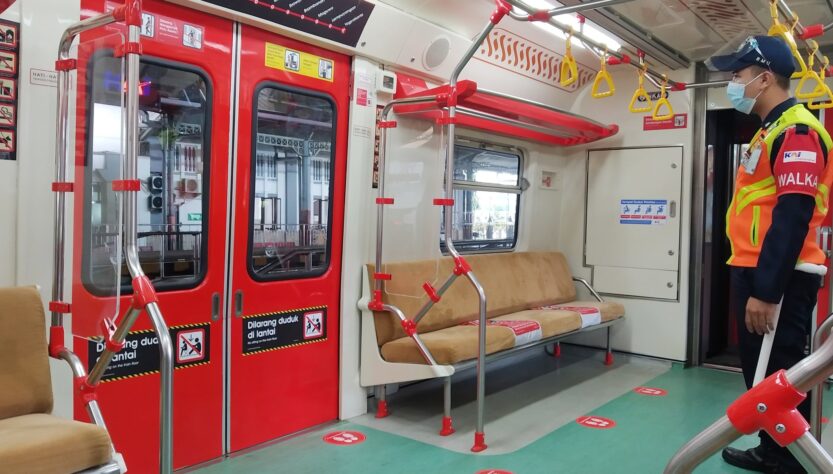
Approaching the long holiday, this article will discuss the addition of the Solo–Yogyakarta KRL schedule during the Eid 2026 period which is good news for the public. This policy is expected to be able to accommodate the significant increase in passengers during the holiday season.
KAI Commuter has officially increased the number of KRL trips on the Yogyakarta – Solo route during the period 22 to 24 March 2026. The total number of trips is now 34 trips per day, providing more time choices for passengers.
VP Corporate Secretary KAI Commuter, Karina Amanda, stated that this addition was made to anticipate a surge in community mobility.
“With the addition of this trip, people have more travel options, both for homecoming, tourism and other activities.”
Passenger surge during Eid
The momentum of Eid al-Fitr is always synonymous with increasing community mobility. The Solo–Jogja KRL route itself is one of the favorite routes because it connects two big cities at an affordable cost and a relatively short travel time.
It is hoped that this additional schedule can reduce passenger density and increase comfort during travel.
Solo-Jogja train schedule (22–24 March 2026)
The following is the departure schedule from several main stations:
From Palur Station:
05.00, 06.05, 07.15, 07.40, 08.56, 10.40, 11.07, 12.10, 12.50, 13.43, 15.35, 16.35, 17.40, 18.05, 19.45, 20.42 WIB
From Solo Balapan Station:
05.13, 06.18, 07.27, 07.52, 09.08, 10.52, 11.19, 12.23, 13.03, 13.55, 15.48, 16.47, 17.52, 18.19, 20.01, 20.54 WIB
Arrive at Yogyakarta Station:
06.23, 07.29, 08.39, 08.57, 10.27, 11.59, 12.41, 13.35, 14.12, 15.06, 16.56, 17.55, 18.57, 19.25, 21.09, 22.01 WIB
Apart from that, schedules are also available from various other stations such as Solo Jebres, Purwosari, Klaten, to Lempuyangan.
Jogja-Solo train schedule (22–24 March 2026)
For the reverse route, here are some of the main schedules:
From Yogyakarta Station:
05.05, 06.00, 07.05, 07.54, 08.49, 09.38, 10.56, 12.07, 12.54, 13.57, 15.01, 16.10, 17.35, 18.08, 19.30, 20.15, 21.20, 22.35 WIB
From Lempuyangan Station:
05.10, 06.06, 07.10, 07.59, 08.54, 09.43, 11.01, 12.12, 12.59, 14.02, 15.06, 16.15, 17.40, 18.13, 19.35, 20.20, 21.25, 22.40 WIB
From Purwosari Station:
06.11, 07.04, 08.09, 08.59, 09.52, 10.40, 12.00, 13.10, 13.56, 15.03, 16.06, 17.26, 18.38, 19.11, 20.32, 21.19, 22.26, 23.41 WIB
This schedule also includes other stations such as Maguwo, Brambanan, Srowot, to Gawok.
Benefits of Adding Schedules
With the increasing frequency of travel, people now have more flexibility in planning trips. Whether for going home, traveling or visiting family, having more time options is certainly very helpful.
Apart from that, congestion at certain hours can also be reduced, so that travel becomes more comfortable and efficient.
Tips for riding the KRL during the Eid holidays
To keep your trip running smoothly, here are some tips you can apply:
- Arrive early to the station to avoid long lines
- Avoid peak hours such as morning and evening
- Prepare a payment card or electronic ticket
- Pay attention to the latest schedule to avoid delays
The addition of the KRL schedule by KAI Commuter on the Yogyakarta – Solo route is the right solution to deal with the surge in passengers during the 2026 Eid al-Fitr holiday.
With a total of 34 trips per day, people can now enjoy more flexible, comfortable and efficient travel during the holiday period.***
PakarPBN
A Private Blog Network (PBN) is a collection of websites that are controlled by a single individual or organization and used primarily to build backlinks to a “money site” in order to influence its ranking in search engines such as Google. The core idea behind a PBN is based on the importance of backlinks in Google’s ranking algorithm. Since Google views backlinks as signals of authority and trust, some website owners attempt to artificially create these signals through a controlled network of sites.
In a typical PBN setup, the owner acquires expired or aged domains that already have existing authority, backlinks, and history. These domains are rebuilt with new content and hosted separately, often using different IP addresses, hosting providers, themes, and ownership details to make them appear unrelated. Within the content published on these sites, links are strategically placed that point to the main website the owner wants to rank higher. By doing this, the owner attempts to pass link equity (also known as “link juice”) from the PBN sites to the target website.
The purpose of a PBN is to give the impression that the target website is naturally earning links from multiple independent sources. If done effectively, this can temporarily improve keyword rankings, increase organic visibility, and drive more traffic from search results.