darulmaarif.net – Indramayu, 22 February 2026 | 01.00 WIB
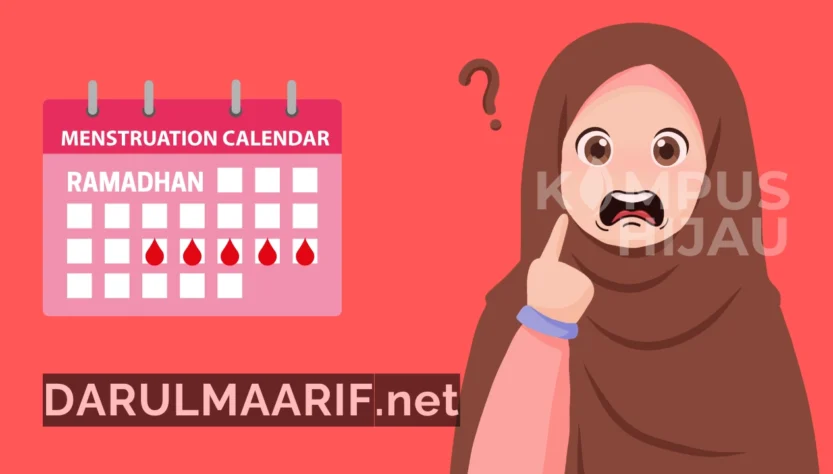
In the midst of the enthusiasm for fasting during Ramadan, quite a few Muslim women experience a sudden situation: during the day while they are fasting, menstrual blood suddenly comes out. In conditions like this, the question often arises, should the fast be canceled immediately? Or will they remain detained until the Maghrib call to prayer as a form of respect for the holy month?
This issue is important to understand, because it concerns whether fasting is valid or not, as well as relating to Sharia law which has been clearly explained by the ulama.
Women’s Menstrual Fasting: Illegal and Obligatory Qodlo
In Islamic jurisprudence, scholars have agreed that it is not valid for women who are menstruating or postpartum to fast. In fact, it is haram for them to fast under these conditions, but they are still obliged to replace it (qodlo) on another day after it is holy.
As stated in Al-Majmu’ by Imam An-Nawawi:
It is not legal for women who are menstruating or postpartum to fast, nor is it obligatory for them. This is haram for them and must be made up for, and all this was agreed upon by acclamation. If he abstains without the intention of fasting, then he does not sin. On the other hand, he is sinful if he intends to fast, even though he does not carry it out. The author mentions here and in the chapter on menstruation evidence of all this, along with what I included there.
[ المجموع – (ج 6 / ص ٢٥٧257)]
Meaning: “The fast of women who are menstruating and postpartum is not valid, is not obligatory for them, and is haram for them, and must be made up for, and everything that has been agreed upon. If she fasts without the intention of fasting, then she is not guilty of this sin if she does it even though her fast is broken.” (Al-Majmu’, Volume VI, Page 257)
This information shows the existence of ijma’ (agreement) of the ulama regarding this law. This means that when menstrual blood comes out during the day, fasting automatically becomes invalid and invalid.
And it is absolutely invalid for menstruating and postpartum women to fast during Ramadan or any other fast, even if only a drop of blood is excreted during the day. Because the condition for fasting is to be free from both. And it is haram to do ‘imsak’ with the intention of fasting and must make up for it another day.
Do you have to eat and drink straight away?
The next question is, do women who menstruate during the day of Ramadan have to immediately eat or drink to break their fast?
The scholars explained that there is no obligation to immediately do things that break the fast. Simply by not having the intention to fast, the fasting status has been invalidated.
In the book Tuhfatul Muhtaj it is explained:
Just like lamps, it is forbidden for women who are menstruating and postpartum to abstain, that is, with the intention of fasting, so it is not obligatory for them to consume something that breaks the fast, the same goes for Eid al-Fitr, unlike people who make it obligatory, and that is enough if there is no intention. [ تحفة المحتاج في شرح المنهاج] – (K.13 / p.373)
Meaning: “And as mentioned in the book Al-Anwar (Misykat Al-Anwar?). It is forbidden for women who are menstruating and postpartum to interpret its meaning with the intention of fasting. intention.” (Tuhafatul Muhataj Fii Syarhil Minhaj, Volume XIII, p. 373)
This means that women who are menstruating cannot fast with the intention of fasting, but they are also not required to eat or drink on purpose. Just lose your intention to fast, then you no longer have fasting status.
When menstruation comes, even for a moment, it still breaks the fast
In the Shafi’iyah jurisprudence literature, it is also emphasized that menstruation, even if only for a moment during the day, still breaks the fast.
As stated in Tuhfatul Habib:
The point is that if any of these things happen during the day, even if only for a moment, apostasy, madness, menstruation, postpartum, and childbirth, then they cause harm and disturb health, and sleep is not harmful even though it takes a day, and if fainting and drunkenness take a day, then it harms health, otherwise not.
Meaning: “In conclusion, in fact apostasy, insanity, menstruation, childbirth, and childbirth if any of these occur in the middle of the day, even briefly, can have fatal consequences, in the sense that the fast is valid, so the fast is prevented. And in fact, sleeping even if the whole day is spent is not valid/does not break the fast. valid).” (Tuhfatul Habib ‘Ala Syarhil Khotib, Volume 3, p. 104)
Thus, menstrual bleeding, even if it is only a drop and occurs only a few moments during the day of Ramadan, still breaks the fast.
A Wise Attitude in Facing This Condition
In daily practice, a Muslim woman who menstruates during the day of Ramadan should:
- Immediately realized that his fast was broken.
- Do not continue fasting with intention.
- There is no sin if you remain abstinent without the intention of fasting.
- It is mandatory to replace the fast outside of Ramadan after it is holy.
This is not a form of deficiency, but rather part of the provisions of the Shari’a which are full of wisdom. Islam does not impose burdens beyond the capabilities and biological conditions that Allah has ordained for women.
Ramadan is not just about enduring hunger and thirst, but about total obedience to Allah’s rules. For Muslim women who menstruate, this obedience is actually visible when they do not fast, because that is the commandment of Islamic law.
That is the beauty of Islam: even when not fasting, a woman remains in worship as long as she follows Allah’s provisions with full awareness and sincerity.
Hope it is useful. Wallohu a’lam.
Berita Terkini
Berita Terbaru
Daftar Terbaru
News
Jasa Impor China
Berita Terbaru
Flash News
RuangJP
Pemilu
Berita Terkini
Prediksi Bola
Technology
Otomotif
Berita Terbaru
Teknologi
Berita terkini
Berita Pemilu
Berita Teknologi
Hiburan
master Slote
Berita Terkini
Pendidikan
Resep
Jasa Backlink
Slot gacor terpercaya
Anime Batch